


CipherWord Master
4.535.00 Reviews
App Specs
- Version
- 1.2.0
- Updated On
- License
- Free
- Downloads
- 50,000+
- Developer
- Word Puzzle Lab
- Categories
- Word
- Platform
- Android
Screenshots
 Analysis by AppCompare
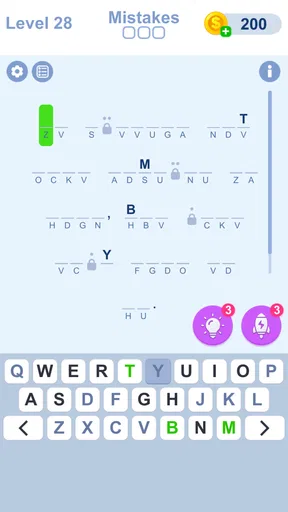
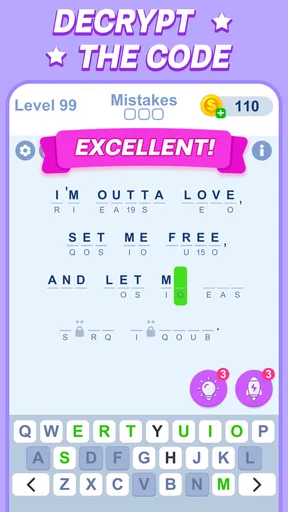
I went into CipherWord Master expecting a familiar word game, but its appeal is more specific than simply filling in letters. The central idea is to work through a coded word puzzle, make a choice, read the response, and decide whether I want to adjust my thinking or start again with a cleaner approach. That small cycle gives the game its identity: every attempt feels like a compact problem-solving exercise rather than a long commitment.
It is a free word game from Word Puzzle Lab, rated for Everyone and available on devices running Android 7.0 or later. The game has reached over 50 thousand installs and holds a 4.5 average from around 393 ratings, which suggests that its straightforward puzzle format has found an audience without needing to be presented as a large, feature-heavy production.
My recommendation depends on what you want from a mobile word game. If you enjoy decoding, testing possibilities, and learning from incorrect guesses, this is an easy game to pick up. If you prefer a rich story, competitive multiplayer, or a large collection of visibly different mini-games, the focused design may feel narrow. I found that narrowness useful in short sessions, although it also becomes the main limitation after repeated play.
How the puzzle loop feels in actual play
I find the puzzle loop easiest to enjoy when I treat each guess as a small experiment: I make a considered move, notice what the response changes, and only then decide what to try next. That approach also makes it easier to tell the difference between a genuinely confusing puzzle and a moment when I simply rushed. Before getting into those habits, it helps to look at what can make the first session feel less smooth than expected.
The first move is simple, but it sets the whole session
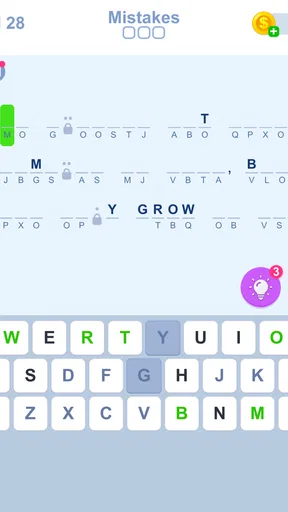
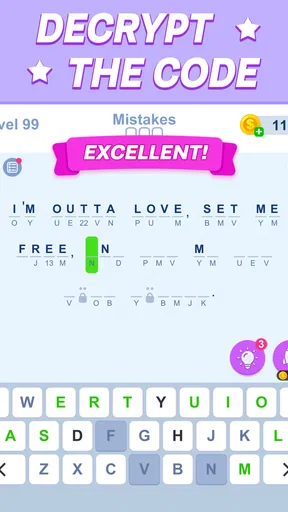
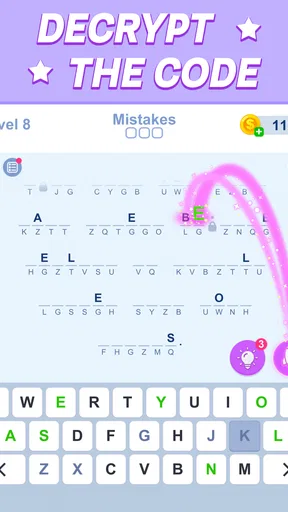
The most important design choice is that CipherWord Master gets me to the puzzle quickly. There is no need to learn a complicated control scheme before making progress. I begin by looking at the coded word and forming an initial theory about what the letters or clues might represent. That first action is not always about being right; it is about creating a starting point that the game can react to.
That makes the opening moment more interesting than a basic anagram where I simply shuffle letters until something looks familiar. I have to decide whether to follow the most obvious interpretation or hold back and inspect the pattern. In practice, I prefer making a deliberate first guess rather than waiting for perfect certainty. The game becomes more engaging when I treat the opening as a hypothesis, not a final answer.
For a quick everyday example, I can imagine opening it while waiting for a coffee or sitting on a short commute. I may have only a few minutes, so I make one attempt, study the response, and either finish the puzzle or leave with a clearer next step. That is a better fit for this game than settling in for a long uninterrupted session. Its basic action is light enough for spare moments, but the reasoning can still hold my attention.
Worth Reading Before You Choose

EA SPORTS FC Mobile 26 Is a Bigger Football Game, but It Takes Time

Flipboard Shows What News Apps Must Do Beyond the Feed

Switching to Android Auto Means Rethinking Your Driving Routine

Google Calendar Makes a Crowded Week Easier to Manage

Ludo King Makes the Most of the Minutes Between Plans

Baby Panda World Brings Quick Play to Modern Phones, but Its Game Library Feels Busy
This also makes the game approachable for people who like wordplay but do not want a dictionary-style challenge. I do not need to memorize obscure vocabulary to enjoy the first layer of play. The satisfaction comes from connecting the code to a possible word and then refining that connection through feedback.
Feedback is what turns guessing into solving
A word puzzle becomes frustrating when an incorrect answer simply disappears without teaching me anything. The useful part of CipherWord Master is the rhythm between an attempt and the information that follows. I make a choice, receive a response, and use that response to narrow the next decision. Even when I miss, the attempt can still move the puzzle forward in my head.
I found it helpful to pause briefly after each response instead of immediately entering another guess. That small habit prevents random trial and error. I look for what the result changes: which interpretation now seems less likely, which letters deserve attention, and whether I have been reading the code too literally. This is one of the better ways to play because it turns feedback into a resource rather than treating it as a simple right-or-wrong signal.
The game rewards a methodical player more than an impulsive one. Someone who enters guesses rapidly may reach an answer, but they may also miss the reasoning that makes the next puzzle easier. I get more from it when I keep a mental record of rejected possibilities. That is a concrete advantage over many casual word games, where the fastest route is often just repeated tapping until the solution appears.
There is a trade-off here. Players who want immediate confirmation after every move may appreciate the directness, while players who expect elaborate explanations may find the feedback too restrained. I would not choose this as a vocabulary tutor or a detailed lesson system. I see it more as a compact logic exercise that encourages me to interpret evidence on my own.
The reward is the change in understanding
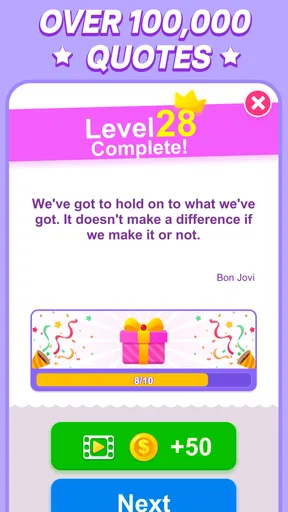
The obvious reward is solving the coded word, but the more satisfying reward is noticing the moment when the puzzle makes sense. A confusing pattern can suddenly become readable after one useful clue or one discarded assumption. That shift is what makes another attempt worthwhile. I am not only chasing completion; I am chasing the feeling of having decoded something that initially resisted me.
This is where the game separates itself from a standard word scramble. In a scramble, the main pleasure is recognizing a familiar word from rearranged letters. Here, the path to the answer matters more. I need to interpret the relationship between the code and the possible solution, so the reward feels closer to solving a small riddle than arranging tiles.
That distinction also affects who will enjoy it. A player who likes crossword clues, deduction, and pattern recognition will probably understand the appeal quickly. Someone who wants a relaxed word game with no wrong turns may find the coded structure more demanding than expected. Neither reaction is wrong; the game asks for a little concentration even when the session itself is short.
I also like that the reward does not require a large presentation to work. The satisfaction comes from the puzzle resolving in my mind, not from needing a complicated progression layer around it. That keeps the focus clear. At the same time, players who need collectibles, character upgrades, or a strong sense of long-term advancement may feel that solving individual puzzles is not enough motivation by itself.
Why the reset makes another round tempting
After a puzzle ends, the natural question is whether I want to try again. The reset is important because it clears the immediate problem while leaving the solving habit intact. I can begin another round without needing a lengthy setup, which creates the familiar “one more puzzle” effect. The next session starts for the same reason the previous one did: I want to test whether I can read the code more efficiently this time.
For me, the best reset is not about chasing a perfect streak. It is about changing my approach. If I rushed through the previous puzzle, I slow down. If I focused too heavily on one possible word, I try to keep more alternatives open. This gives the restart a practical purpose rather than making it a simple repetition of the same tapping pattern.
That short reset also makes the game suitable for different attention levels. I can play one puzzle when I am tired, or continue when I am in the mood to concentrate. It does not demand that I remember a complicated story or maintain a large collection of resources between sessions. The downside is that players who need a strong long-term structure may eventually ask what changes from one session to the next beyond the puzzle itself.
I would skip it if my main goal were a social word game. There is no reason in the core experience to choose it over a title built around live matches, shared challenges, or visible rankings. I would also skip it when I want a broad language-learning tool with definitions and examples. Its strength is the focused act of decoding, not the surrounding systems found in those alternatives.
Useful habits for getting more from each puzzle
My first practical tip is to avoid treating the opening guess as a commitment. I use it to expose the puzzle’s direction. If the response weakens my first idea, that is useful information rather than wasted progress. This mindset reduces the temptation to force every later thought to fit the original answer.
Second, I separate recognition from confirmation. Sometimes a possible word appears quickly, but I wait to see whether the available feedback supports it. That extra pause is especially useful when several words share similar patterns. It helps me avoid the common mistake of accepting the first familiar-looking answer.
Third, I use a reset as a review of my process. When I begin another session, I ask myself whether I was guessing randomly, overlooking a pattern, or abandoning a reasonable idea too soon. This makes repeated play more valuable because I am improving my method, not merely repeating inputs.
A fourth tip is to play in short, deliberate blocks instead of leaving the game open while distracted. CipherWord Master benefits from attention to small details. If I am constantly switching between messages and the puzzle, the feedback loses some of its value. A few focused minutes can be more satisfying than a longer session played carelessly.
Where it fits among familiar word-game choices
Compared with a classic crossword, CipherWord Master feels more immediate and less dependent on working across a large grid. I do not need to manage intersecting answers or maintain a broad page of clues. That makes it easier to start, but it also means I do not get the layered satisfaction of using one answer to unlock several others.
Compared with a typical anagram game, it asks for more interpretation before the answer becomes obvious. An anagram often rewards vocabulary recall and fast rearrangement; this game gives more weight to decoding and response analysis. Players who enjoy quick word recognition may prefer the faster alternative, while players who like narrowing possibilities may find the coded format more rewarding.
Compared with a daily word challenge, the appeal is less tied to a single shared result. A daily format can create a strong routine and a sense of conversation with other players. CipherWord Master works better when I want to play on my own schedule and continue because I am curious about the next puzzle, not because a particular daily window is waiting for me.
Those comparisons point to a clear trade-off: this is a focused puzzle tool rather than an all-purpose word-game collection. I appreciate that it does not need to imitate every other format. Still, anyone who values variety should understand that the same central loop is both the reason to install it and the reason it may eventually feel repetitive.
Practical details before installing
The game is free to install, which makes trying the core experience a low-risk decision. There are in-app purchases ranging from $0.99 to $99.99 per item, so I would pay attention to the purchase flow and avoid assuming that every optional element is included simply because the initial download costs nothing. For a casual player, the sensible approach is to start without spending and decide later whether the extra purchase options add enough value.
The Everyone content rating makes it suitable for a broad audience from an age-classification perspective. I would still choose it according to the player’s taste rather than the rating alone. A younger player who enjoys word deduction may find it approachable, while someone looking for action or visual spectacle will probably lose interest regardless of age.
The current version is 1.2.0, and the game was released on July 18, 2024. Those details matter mainly because they place the app as a relatively recent, focused word title rather than a long-established platform with years of accumulated systems. Word Puzzle Lab has kept the presentation centered on the coded-puzzle concept, which is good for clarity but leaves less room for users who expect a mature ecosystem around the game.
On Android, the minimum requirement of version 7.0 or later covers many older devices, so compatibility should not be a major obstacle for people using a reasonably maintained phone or tablet. I would still check the device’s available storage and system condition before installing any game, especially on an older phone where background apps can affect responsiveness.
Who should play it, and who should move on
I would recommend CipherWord Master to people who enjoy word puzzles that ask them to think in steps. It is a good match for a commuter, a student wanting a short mental break, or an adult who likes deduction but does not want to commit to a full crossword. The feedback loop gives each attempt a purpose, and the quick reset makes it easy to stop without feeling that a long session was interrupted.
I would be more cautious about recommending it to players who need constant novelty. If your ideal game changes rules every few minutes, includes social competition, or builds a large progression system around each success, this focused format may not hold your attention. The same applies to people who dislike uncertainty in word puzzles. The game expects you to tolerate a few wrong turns and use them intelligently.
It is also not my first choice for formal language study. Solving a coded word can strengthen attention and flexible thinking, but that is different from learning pronunciation, grammar, definitions, or usage. For those goals, a dedicated language app is the better tool. CipherWord Master works best as a recreational exercise with a useful mental edge, not as a replacement for structured instruction.
My verdict on the complete action-feedback-reward-reset loop
What keeps me returning is the clean sequence: I make a first move, read the response, experience the satisfaction of a clearer interpretation, and then decide whether to reset for another puzzle. The loop is easy to understand but not completely mindless. Each new session offers a chance to apply a better habit, which gives the restart more meaning than simply pressing a replay button.
Its weaknesses are equally clear. The focused design will not satisfy everyone, and the purchase range means free installation should not be confused with every possible option being free. Players looking for social features, story, extensive progression, or educational explanations should choose a different type of word app. Even fans of deduction may want a second game available when they need a change of pace.
For my own use, though, the balance works. I can open it for a short break, make a thoughtful attempt, learn from the feedback, and either finish or return later without losing the point of the experience. The best reason to try it is not the promise of endless variety, but the satisfaction of turning one uncertain code into a clear answer. If that compact challenge sounds more appealing than a conventional scramble, CipherWord Master is worth installing and testing for yourself.
Pros
- Offline play lets you enjoy puzzles without a constant internet connection.
- Multiple difficulty levels make it suitable for both beginners and word experts.
- Clean interface keeps the focus on solving clues rather than navigating menus.
- Short rounds work well for quick sessions during commutes or breaks.
- Word challenges can help improve spelling
- vocabulary
- and pattern recognition.
Cons
- Some puzzles may feel repetitive after extended play sessions.
- Advanced levels can become frustrating without useful clue variety.
- Small text or tiles may be difficult to read on compact phone screens.
- Progression may feel slow if new content unlocks gradually.
- Ads can interrupt the experience unless an ad-free option is available.
FAQs for CipherWord Master
What is CipherWord Master and how does the game work?
CipherWord Master is a word puzzle game built around decoding hidden words and solving cipher-style challenges. In each round, you use the available clues, letters, symbols, or patterns to discover the correct answer. The game is designed for short sessions, but later puzzles can require careful deduction, vocabulary knowledge, and attention to detail rather than simple guessing.
Is CipherWord Master suitable for beginners and casual players?
Yes, CipherWord Master can be approachable for beginners because its basic concept is easy to understand and the early challenges generally help players learn the mechanics. However, the difficulty may increase as you progress, especially when clues become less direct or the word combinations are more complex. Players who enjoy crosswords, riddles, and logic games should find the learning curve comfortable.
Does CipherWord Master work without an internet connection?
Some puzzle features may be available offline, which makes CipherWord Master convenient for playing during travel or when mobile data is limited. Nevertheless, internet access may still be required for downloading the game, receiving updates, synchronizing progress, displaying advertisements, or using online features. Availability can depend on the version installed and the device, so checking the store description is recommended.
Are there hints, rewards, or in-app purchases in CipherWord Master?
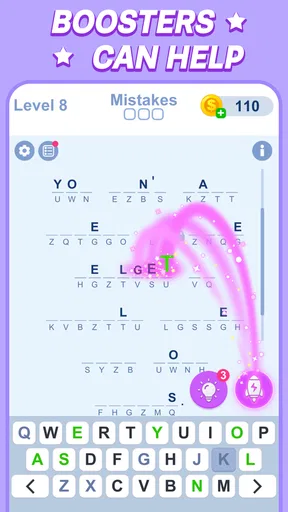
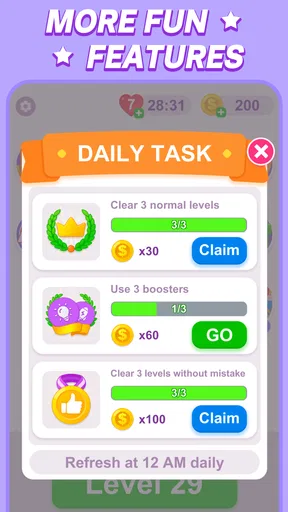
CipherWord Master may include assistance features such as hints, letter reveals, or other rewards to help when a puzzle becomes difficult. Depending on the version, these resources can be earned through gameplay, advertisements, daily activities, or optional purchases. Before downloading, review the current store listing and in-app purchase information if you prefer a completely free experience without spending money.
What devices are compatible with CipherWord Master?
CipherWord Master is intended for mobile devices running a supported version of Android or iOS. Compatibility can vary according to the operating system version, available storage, screen size, and the developer’s latest requirements. The safest approach is to open the official Google Play or App Store listing on your device and confirm that the installation button is available before attempting to download the game.


